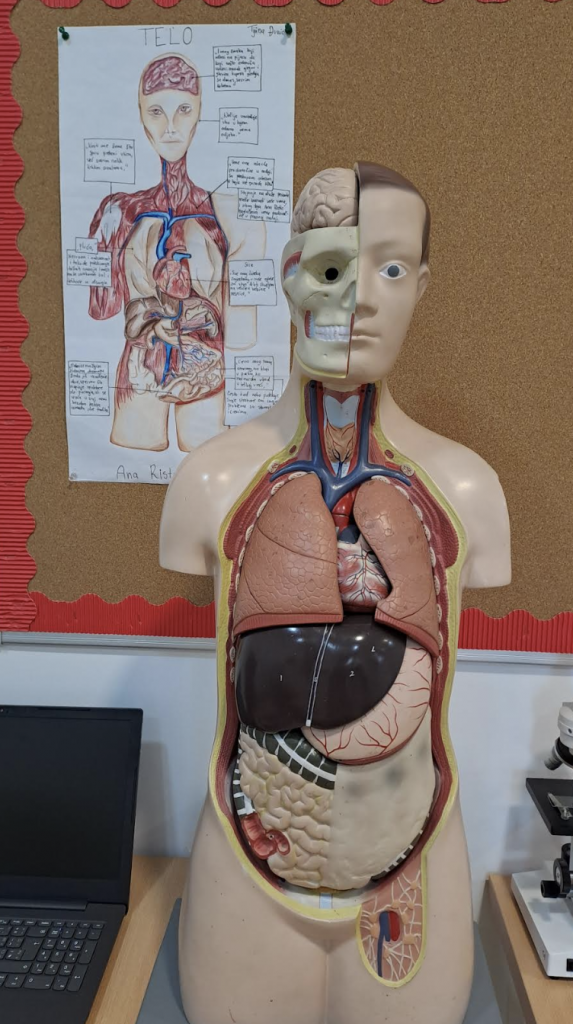

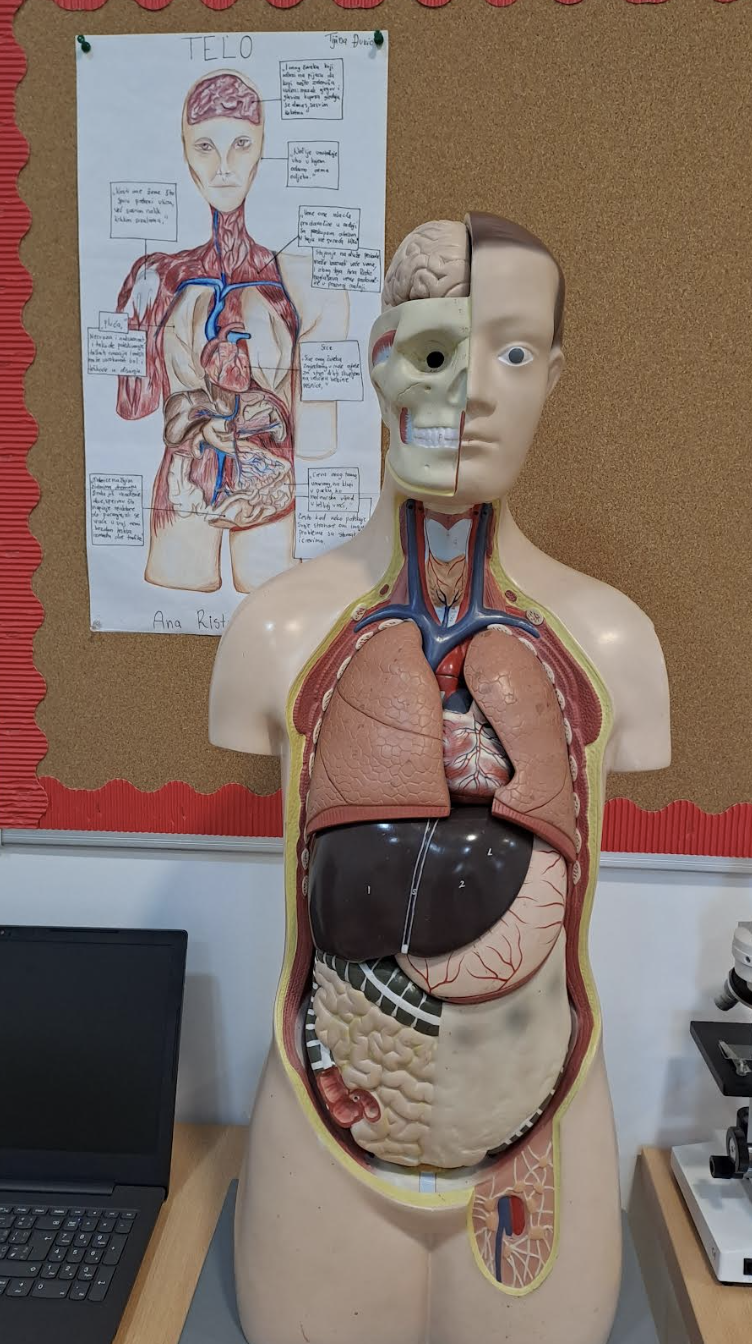
In our shared classroom — a space where literature and biology coexist — something remarkable has quietly taken shape. Just above the poster inspired by Ana Ristović’s poem “Telo”, a life-sized anatomical model now stands, its internal organs visible in precise scientific detail. What began as a poetic interpretation has evolved into a living dialogue between art and science.
Last term, a DP Year 12 student responded creatively to Ristović’s poem by drawing the human body and pairing each organ with carefully selected lines from the text. The result was a “poetic anatomical map,” where metaphors became visible and imagery took on colour and form. Now, with the addition of the anatomical model in the classroom, the connection feels almost symbolic — as though poetry itself has stepped into three dimensions.
Ristović’s verses invite readers to see the body not merely as biology, but as memory, emotion, and language. A heart described as “the size of a baby’s fist” is no longer just a muscle; it becomes tenderness and vulnerability. “Intestines like sailors’ ropes” move beyond physiology into metaphor. The brain shifts from an organ of neurons to a quiet observer of everyday life.
And now, directly beneath the model’s carefully structured organs, those same images resonate differently. Students can look up and see the scientific precision of arteries and lungs, then glance down and rediscover them transformed through poetry. The classroom itself becomes a space of layered meaning — where facts and feelings coexist.
The presence of the anatomical figure above the poetic poster creates a powerful visual metaphor. Science explains how the body functions; literature explores what the body signifies. One offers structure, the other interpretation. Together, they remind us that education is richest when disciplines do not stand apart, but converse.
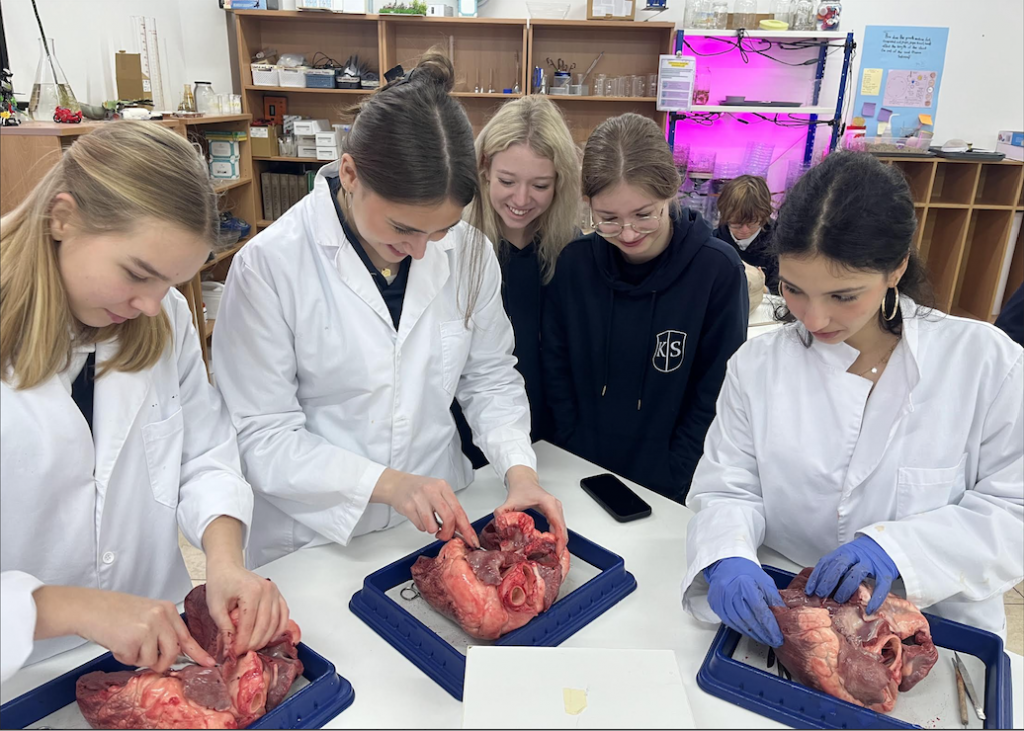
In addition to the poetic and visual exploration of the human body inspired by Ana Ristović’s “Telo”, our Y13 HL Biology students have been engaging in a hands-on study of the cardiovascular system. As part of their unit on Body Systems, they recently performed a heart dissection, examining the flow of blood through the heart, the structure of arteries, veins, and capillaries, and discussing issues such as coronary heart disease.
This practical activity complements the poetic and artistic interpretations in the classroom, providing students with both a scientific and a creative understanding of the human body. We have included a photo of the heart dissection to give a visual insight into this learning experience, showing how literature, art, and biology can intersect in inspiring ways.
In this shared space between the literature teacher and the biology teacher, students are encouraged to understand that knowledge is interconnected. The heart can be studied through diagrams and through metaphor. The brain can be examined under a microscope and within a stanza. Learning does not have to choose between analysis and imagination.
Moments like this reveal the beauty of interdisciplinary teaching. A simple classroom arrangement — a model above a poster — becomes a statement: the human being is both physical and poetic. And perhaps that is the most important lesson our students can carry with them — that understanding the world requires both careful observation and creative interpretation.